Engine Fitment Check: How to Verify the Right Fit Before You Buy?
Why Most Used Engine Swaps Fail Before They Start?
A driver in Phoenix chose a 2AZ-FE engine replacement for his 2012 Camry. The seller said it would fit his car, but the bay it sat in for two weeks said otherwise: wrong mounts, wrong ECU pinout, and wrong transmission bolt pattern. By the time he called us, he was out $3,400 on the engine and $600 in shop labor, and his Camry was still on jack stands. He could have prevented it all if he had done some research about the engine VIN decoder.

This happens every week. The reason is simple: most buyers compare engines by year and displacement, and mechanics don't. An engine fitment check is a structured verification process built on engine codes, generation breaks, ECU pinouts, harness connectors, and transmission mating. Get any one of those wrong, and the swap fails sometimes after the engine is already in the car.
This guide will walk you through exactly how a working mechanic verifies fitment before a single bolt comes out.
What Is an Engine Fitment Check?
An engine fitment check is a process that confirms whether a VIN-matched replacement engine will physically fit, electrically connect, and mechanically operate in your vehicle. It requires matching six things:
Engine code, e.g., 2AZ-FE, not just "2.4L Toyota"
Generation/production year range
Vehicle sub-model and trim
ECU/PCM compatibility
Wiring harness connectors
Transmission bell housing and mounts
Visual similarity is meaningless. Two engines from the same manufacturer in the same vehicle line can share 80% of their casting and still be non-interchangeable. The fastest way to find engine size is by VIN and confirm the exact engine your vehicle left the factory with is to decode the 17-character VIN before you contact any supplier. Your VIN engine size designation, the 8th character, is the single identifier that the factory's engine code is tied to.
Engine Codes: The Only Reliable Starting Point
Engine codes are the manufacturer's own identifier for a specific block, head, and configuration. They're stamped on the block, printed on the parts catalog, and tied to the VIN. The engine code is the first thing that a mechanic verifies when confirming the fitment, not the displacement or the badge.

The easiest way to confirm your VIN is a free engine VIN decoder. The 8th character of any US-market VIN is the engine designation. That single character is what links your vehicle to a specific engine code, displacement, and emissions package. An engine code lookup against that character returns the exact engine family the factory installed.
Example: 2AZ-FE vs. 2AR-FE
These two Toyota inline-fours are responsible for more failed swaps than almost any other pair we see. They both power Camrys, RAV4s, and Highlanders. They look nearly identical at a glance, but they are not interchangeable.
2AZ-FE, 2.4 L, single VVT-i.
Production: 2001–2012
Bore x Stroke: 88.5mm x 96mm
Found in: Camry 2002–2011 base 4-cyl, Highlander 2001–2007 base, RAV4 2006–2008, Scion tC 2005–2010, Solara 2002–2008, and Matrix XRS 2003–2008.
Known issue: head bolt thread pull on aluminum block, common in higher-mileage units
2AR-FE, 2.5L, dual VVT-i
Production: 2008–2017+
Bore x Stroke: 90mm x 98mm
Found in: Camry 2010–2017, Venza 2009–2015, RAV4 2009–2018, Highlander base 2011–2013, and Scion tC 2011–2016.
Different block deck, different head, different intake/exhaust VVT actuation, different sensor placement
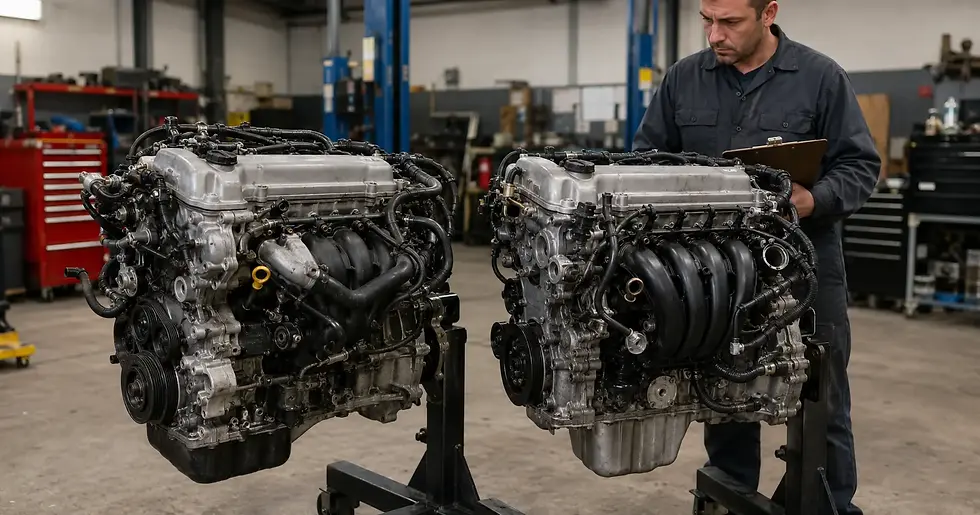
A 2012 Camry takes a 2AR-FE. Drop a 2AZ-FE into it, and the engine sits in the bay looking right but doesn't talk to the ECU, doesn't mate to the U760E transmission, and won't pass even a key-on self-test. A 30-second engine code lookup against the Phoenix driver's VIN would have flagged the mismatch before he paid for the engine.
Generation Breaks Matter More Than Years
Even within the same engine code, there are different generation breaks. The 2AR-FE in a 2010 Camry uses a different intake manifold and slightly different sensor cluster than a 2015 2AR-FE. But both share the same block. The accessories aren't always there.
This is why "I have a 2.5L Camry; will any 2.5L work?" is the wrong question. The right question is, "Which sub-generation of 2AR-FE matches my year, submodel, and emissions package?" Run the Toyota engine code lookup against your exact VIN, not against the model year alone. Mid-year production splits are common, and the VIN is the only true source.
Compatibility Table: 2AZ-FE / 2AR-FE Swap Reality
This table shows the real-world outcome of common cross-year, cross-engine attempts. "Direct fit" means OEM-spec replacement with no modification. "Modification required" means it can be made to work with specific part changes. "Not compatible" means do not attempt.
Source Engine | Target Vehicle | Outcome | Notes |
2AZ-FE 2007. | 2008 Camry 2.4L | Direct fit | Same engine code, same generation |
2AZ-FE 2005 | 2009 Camry 2.4L | Direct fit | Still the 2AZ-FE platform, final year of overlap |
2AZ-FE 2008 | 2010 Camry 2.5L | Not compatible | 2AR-FE only, wrong ECU, wrong trans, wrong mounts |
2AR-FE 2012 | 2009 Camry 2.4L | Not compatible | Wrong harness pinout, wrong PCM, wrong U241E mating |
2AR-FE, 2013 | 2015 Camry 2.5L | Direct fit | Same generation, full interchange |
2AR-FE 2010 | 2017 Camry 2.5L | Modification required | Sensor and intake updates between generations |
2AZ-FE Scion tC | 2007 Camry | Modification required | Same code, different oil pan, and accessory layout |
2AR-FE RAV4 | 2014 Camry | Modification required | Same code, different mounts, and intake routing |
The table tells you something that every mechanic has to learn the hard way: an engine code is necessary but not sufficient. Sub-model variations within the same code can still require part swaps to complete the install.
Technical Deep Dive: The Four Compatibility Pillars
A real fitment check examines four mechanical and electrical systems. Skip any one of them and the swap stalls. Before you start, find the engine size by VIN on both the engine, if its VIN is available, and your own vehicle. This number is the baseline every other check builds on.
1. Mounting Points
Engine mounts attach the block to the vehicle frame. They're engine-specific and vehicle-specific. Even when two engines share the same code, the mounting bosses can be in different positions if the donor vehicle had a different transmission orientation, AWD layout, or accessory routing.
A used Toyota Solara 2AZ-FE engine may share the same base code as a Camry 2AZ-FE engine, but brackets and accessory layouts can differ. A direct-from-Solara engine in a Camry bay will require Camry brackets, not Solara brackets.
2. ECU / PCM Compatibility
The ECU, or engine control unit, or PCM, or powertrain control module, controls fuel, timing, and emissions based on signals from the engine. Each engine generation has its own firmware map, and the ECU expects specific sensor signals at specific pins.

Your VIN's engine size designation drives the ECU pairing. That 8th character in the VIN is what the factory used to flash the correct firmware to your specific module. A 2AR-FE engine that is running on a 2AZ-FE ECU will immediately generate error codes. The system may report errors such as an incorrect VVT signal type, dual vs. single, improper knock sensor placement, and incorrect mass airflow scaling. The engine may start, but it will not run correctly, and it will fail the emissions test.
When the right mechanic verifies fitment, the engine code is the first thing they confirm, not the displacement, not the badge.
The donor engine's ECU is included or matched separately
The ECU's part number matches the buyer's vehicle year and emissions package
Immobilizer/anti-theft pairing is addressed; the ECU and key system have to handshake.
3. Wiring Harness Differences
Engine harnesses connect every sensor, injector, coil, and actuator on the engine back to the ECU. Different engine generations use different connectors, have different pin counts, and sometimes have different protocols.
A 2AZ-FE harness has fewer connectors than a 2AR-FE harness. The 2AR's dual VVT-i adds an exhaust sensor for the cam position and a second oil control valve. Plug-and-play between them is not possible. The options are:
Use the donor engine's harness if the connectors match the buyer's vehicle, which is rare across generations.
Swap the harness from the original vehicle onto the new engine; it works if the engine codes match.
Source a vehicle-correct harness separately ($200–$600 used).
4. Transmission Compatibility
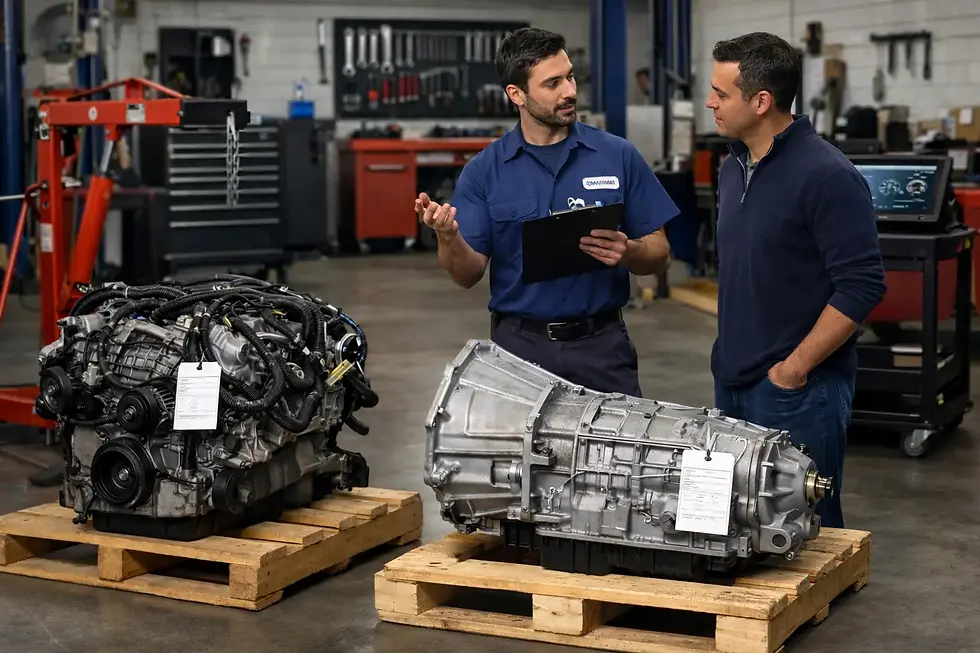
The transmission bolts to the back of the engine via the bellhousing. Bellhousing bolt patterns are not universal, even within the same manufacturer.
A used Toyota engine (2AZ-FE) assembly must be matched with the correct transmission family and vehicle-specific hardware.
2AR-FE pairs with the U760E 6-speed automatic or AR710 in newer applications. The bell housing pattern is different from the U241E.
If the new engine and the existing transmission don't share a bell housing pattern, the buyer needs a matching used Toyota transmission, too.
Real Mechanic Insights: What We See Go Wrong

After thousands of engine sales, the same failure patterns repeat:
The "close enough" purchase
The buyer sees a 2.4L Toyota engine at a low price, assumes it fits a 2.4L Toyota vehicle, and doesn't check the code. The 2AZ-FE and 1AZ-FSE engines share the same displacement, but they differ in all other aspects. A 60-second VIN lookup prevents such errors every time.
Wrong mileage assumptions
A 90,000-mile 2AZ-FE with a stripped head bolt is worth less than a 130,000-mile unit that's been pulled clean. Mileage is one input, but service history and inspection condition matter more.
Skipping the engine code lookup
Most buyers skip this step entirely and rely on the seller's word, which is exactly how junkyard engine reliability becomes a gamble. A VIN tells you the exact engine, ECU part number, transmission, and emissions package your vehicle left the factory with. Ignoring it is the most common cause of failed engine swaps.
Buying without the harness or ECU
A "bare" engine costs less but adds compatibility risk. Cross-generation buyers should
Secure the ECU and harness supply before the engine ships.
Ignoring sub-model fitment
The same engine code but different sub-models, sedan vs. coupe vs. SUV, can mean different oil pans, accessory brackets, intake routing, and exhaust manifolds.
Mistakes to Avoid
Don't buy on displacement alone. "2.4 L" and "2.5 L" are marketing terms. Engine codes are engineering.
Don't skip the VIN check. Use an engine VIN decoder to confirm your engine before contacting any supplier. It saves hours and dollars.
Don't guess your displacement. Find engine size by VIN. Your owner's manual can be wrong, especially in used vehicles where the engine may have been swapped. The VIN is the only authoritative source.
Don't assume year ranges are clean. Mid-year production changes exist. A 2009 Camry could be an early-build 2AZ-FE or a late-build 2AR-FE, depending on the production date. Run an engine code lookup against the actual VIN.
Don't assume year ranges are clean. Midyear production changes exist, and Toyota Camry engine compatibility often shifts based on the build date instead of the model year. A 2009 Camry could be an early-build 2AZ-FE or a late-build 2AR-FE, depending on the production date. Run an engine code lookup against the actual VIN.
Don't ignore the emissions package. Confirm that the VIN engine size designation matches your vehicle's emissions tier. California-spec and federal-spec engines with the same code can have different sensors and catalytic converters.
Don't accept "it'll work" without a matching part number. Ask the supplier for the engine code, casting numbers, and donor vehicle VIN if available.
Final Takeaway
An engine fitment check isn't a step you skip to save time. It's the one filter that decides whether your replacement engine becomes a working powertrain or an expensive paperweight sitting in your driveway. Every failed swap we've seen, including the 2012 Camry that opened this guide, follows the same pattern: the buyer trusted displacement, a badge, or a seller's word instead of the data the factory already encoded into the VIN. The engines that go in clean are the ones where the engine code, ECU, harness, transmission, and sub-model were all confirmed before any money changed hands.
Frequently Asked Questions
How do I find my engine code?
You can find your engine code in three places: the engine block itself, stamped usually near the bell housing or on the front pad; the driver's-side doorjamb sticker; and the specifications section of your owner's manual. The VIN method is the most accurate of the three.
How do I find the engine size by VIN?
The 8th character of your 17-character VIN is the engine identifier. Run your VIN through a free decoder, or a manufacturer lookup, or a parts retailer's tool, and it will return the exact engine code, displacement, and configuration.
What does the VIN's engine-size character mean?
The VIN engine size character, 8th position, maps to a manufacturer-specific code that identifies the engine family, displacement, fuel system, and, often, the emissions package.
Is a same-code engine always a direct fit?
No, not always. The same engine code with different submodels and different vehicle lines can require accessory, mount, or oil pan changes. The same code within the same vehicle line is usually a direct fit.
Can I install a JDM engine in a US-spec vehicle?
A JDM engine replacement may share the same code as a US-spec engine but still differ in emissions equipment and sensor layout. So it's better to verify all the other aspects for a successful engine swap.
Do I need a new transmission with a different engine?
Only if the bellhousing pattern is different. Within the same engine code, the existing transmission usually works. Across generations, like from the 2AZ-FE to the 2AR-FE, the transmission must change too.