
Toyota Camry Engine Compatibility Guide
Updated: Apr 21
The $2,800 Mistake That Could Have Been Avoided
A shop in Ohio ordered a 2.4L engine for a 2007 Camry. The replacement arrived, looked identical, and bolted in without issue until the customer came back two weeks later with a check engine light and a transmission that slipped between 2nd and 3rd gear. The engine was from a 2009 Camry. Same displacement, same looks, different ECU calibration and a slightly different torque converter lockup strategy. Total repair bill to sort it out: $2,800 on top of the original swap.
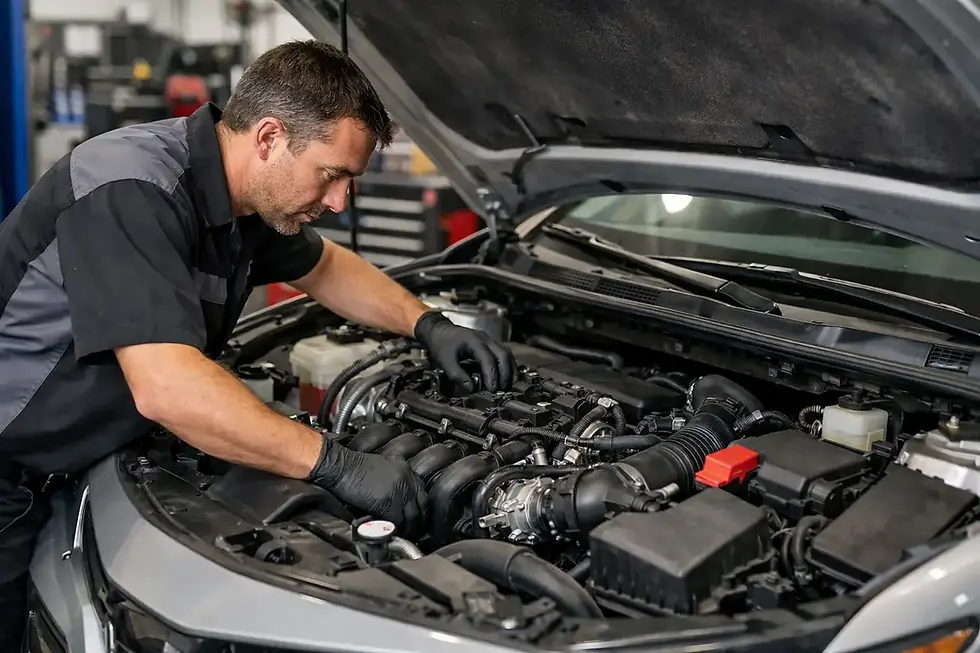
This guide exists so that it does not happen to you. Camry engine compatibility is not as simple as matching displacement or even engine codes. Generation overlap, ECU pairing, wiring harness revisions, and even emission certification requirements can turn what looks like a direct swap into an expensive headache.
Whether you are a DIY enthusiast, a shop tech, or a buyer sourcing a used Toyota engine, this guide gives you the exact facts, engine codes, year-by-year fitment, what can be made to work with modifications, and what you should simply walk away from.
Quick Answer: Camry Engine Compatibility at a Glance
The Short Version
Camry engines are generation-specific, not simply year-specific. The 2AZ-FE (2002–2011, 4-cylinder) swaps cleanly within its own generation. The 2GR-FE (2006–2017, V6) follows the same rule. Crossing generations, for example, putting a 2AR-FE from a 2014 into a 2007 requires ECU reprogramming and often wiring harness modifications. Direct swaps are typically safe within the same engine family, especially when using a 2.5L 2AR-FE Camry engine from the same generation. Cross-generation swaps range from "manageable with work" to "not worth it financially."
Engine Codes, Generations, and What They Mean
Fifth Generation (1997–2001) — XV20

The XV20 platform introduced the 5S-FE (2.2L inline-4) and the 1MZ-FE (3.0L V6) to the Camry lineup. The 5S-FE produced around 133 hp and used a distributor-based ignition system, a clear indicator of its age. The 1MZ-FE in this generation made 194 hp and was shared with the Avalon and Sienna, which expanded the used parts market considerably.
• 5S-FE: 2.2L, DOHC, distributor ignition, OBD-II compliant
• 1MZ-FE: 3.0L V6, DOHC, 24-valve, used in Sienna/Avalon/ES300 very wide parts availability
Sixth Generation (2002–2006) — XV30
Toyota replaced the 5S-FE with the 2AZ-FE for 2002. This was a significant engineering step. The 2AZ-FE is a 2.4L DOHC four-cylinder with dual VVT-i on the intake cam only (early units) and later dual VVT-i on both cams. It produced 157–160 hp, depending on model year and became one of Toyota's most widely used platforms.
• 2AZ-FE: 2.4L, DOHC, VVT-i, 157–160 hp, aluminium block, hydraulic VVT actuators
• 3MZ-FE: 3.3L V6, DOHC, 24-valve, 210 hp, replaced the 1MZ-FE in SE/XLE trims
Note: The 3MZ-FE shares its basic architecture with the 1MZ-FE but is NOT a drop-in swap due to different oil pan geometry, slightly longer block, and ECU differences.
Seventh Generation (2007–2011) — XV40
The XV40 generation kept the 2AZ-FE for base trims but updated the V6 to the 2GR-FE, arguably the best all-around engine Toyota produced in this era. The 2GR-FE is a 3.5L V6 with dual VVT-i, an aluminium block, and 268 hp. It is still widely regarded as extremely reliable.
• 2AZ-FE: Carried over from XV30 but with revised engine management calibration not identical to ECU mapping
• 2GR-FE: 3.5L V6, 268 hp, dual VVT-i, used in Camry/Avalon/Highlander/RAV4 V6, enormous used market
Eighth Generation (2012–2017) — XV50
The 2012 Camry brought the 2AR-FE to replace the ageing 2AZ-FE. The 2AR-FE is a 2.5L four-cylinder producing 178 hp, a meaningful jump over its predecessor. The V6 slot was filled by the updated 2GR-FE with slight calibration changes.
• 2AR-FE: 2.5L, DOHC, Dual VVT-i (both cams), 178 hp, different stroke and bore than 2AZ-FE, NOT interchangeable
• 2GR-FE (revised): Same block as XV40, but revised ECU mapping, EGR system differences in some states
Ninth Generation (2018–Present) — XV70
The current Camry uses the A25A-FKS (2.5L Dynamic Force four-cylinder) and the 2GR-FKS (3.5L V6), both of which are part of Toyota's TNGA platform and use an Atkinson-cycle combustion mode. These engines are paired with Toyota's Direct Shift 8-speed automatic transmission and are fundamentally incompatible with pre-2018 Camry platforms without essentially full vehicle re-engineering.
• A25A-FKS: 2.5L, 203 hp, Atkinson/Otto cycle, paired exclusively with Toyota's new 8-speed, do NOT attempt transplant into pre-2018 chassis
• 2GR-FKS: 3.5L, 301 hp, port + direct injection (D-4ST), similar concerns; treat this as generation-locked
Camry Engine Compatibility Table — Year vs. Year

Read this table as: source engine year (left column) being installed into target vehicle year (top header). "Direct Fit" means bolt-in with no significant changes required. "Mod Required" means it can be done but needs work. "Not Compatible" means the cost and complexity make it impractical.
Engine Source → Target Vehicle ↓ | 1997–01 5S-FE / 1MZ | 2002–06 2AZ / 3MZ | 2007–11 2AZ / 2GR | 2012–17 2AR / 2GR | 2018+ A25A / 2GR-FKS | Notes |
1997–2001 Camry | Direct Fit | Mod Required | Not Compatible | Not Compatible | Not Compatible | ECU and harness major work for XV30+ |
2002–2006 Camry | Mod Required | Direct Fit | Direct Fit* | Mod Required | Not Compatible | *ECU recal needed for 07–11 into 02–06 |
2007–2011 Camry | Not Compatible | Direct Fit* | Direct Fit | Mod Required | Not Compatible | *2AZ-FE from 02–06 needs ECU recal in 07–11 host |
2012–2017 Camry | Not Compatible | Mod Required | Mod Required | Direct Fit | Not Compatible | 2AR-FE will not fit pre-2012 without major work |
2018+ Camry | Not Compatible | Not Compatible | Not Compatible | Not Compatible | Direct Fit | TNGA platform is generation-locked |
For example, a 2010–2011 2AR-FE Camry engine is commonly used for same-generation replacements due to straightforward fitment.
Legend: Direct Fit = bolt-in swap, same engine code or confirmed compatible. Mod Required = doable but needs ECU reprogramming, harness adaptation, or both. Not Compatible = impractical; the cost exceeds the value of the repair.
Technical Deep Dive: Why Compatibility Works — or Doesn't
Mounting Points
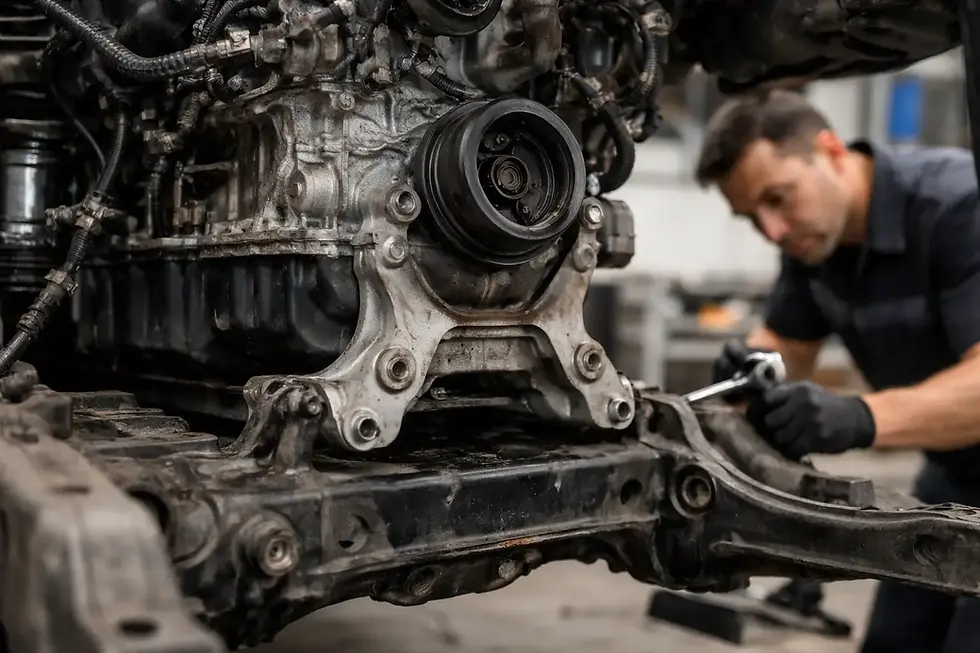
Toyota largely standardised engine mounting geometry within each generation, which is good news for same-generation swaps. However, the transition from XV30 to XV40 included a revised front subframe design that moved the driver-side engine mount approximately 8mm forward. This means a 2AZ-FE from a 2005 Camry technically bolts to the same type of mounts as a 2007, but the bracket positioning requires shimming or a modified mount bracket on the driver side. It is small, but it matters.
The 2GR-FE in the V6 Camry used a completely different mount configuration from the 4-cylinder chassis. If you are attempting a V6 engine in a 4-cylinder Camry, you will need V6-specific motor mounts, a front crossmember from a V6 donor car, and possibly a modified oil pan, depending on subframe clearance.
ECU and PCM Compatibility
This is where most amateur swaps go wrong. Toyota's engine control units in the Camry are VIN-locked starting from the XV40 generation (2007+). A replacement ECU from a junkyard car will require dealer-level reprogramming to work with the vehicle's immobilizer and body control module. You cannot simply swap ECUs and expect a clean start.

For the 2AZ-FE specifically, the XV30 and XV40 ECUs use different calibration maps, idle control strategies differ, and the throttle-by-wire system on the 2007+ cars is not backwards-compatible with the cable-throttle setup of 2002–2006 models. If you pull a 2AZ-FE from a 2009 Camry and drop it into a 2004, you will need either the 2004's original intake manifold (which has the cable throttle body) or you will need to adapt the electronic throttle control.
• 2002–2006: Cable throttle. ECU communicates via a 22-pin and 28-pin harness.
• 2007–2011: Electronic throttle control (ETC). ECU uses a 32-pin main harness.
• 2012–2017: Fully integrated ETC with revised ETCS-i. Incompatible with pre-2012 harnesses without complete re-pin.
Wiring Harness Differences
A wiring harness swap is often the deciding factor in whether a cross-generation engine swap is worth pursuing. The Camry underwent hardware revisions at each generation change, with the XV40-to-XV50 transition being particularly significant,Toyota added active noise cancellation wiring, a revised VSC integration, and a new CAN bus architecture that is incompatible with earlier systems.
For same-generation swaps: generally, the engine harness can be transferred directly from the donor engine. The chassis harness stays with the car, and the engine harness plugs in without issue if the Toyota engine codes match.
For cross-generation swaps, you have three options: (1) use the engine's original harness and splice into the chassis, labour-intensive but clean when done right; (2) use a standalone ECU like a Link G4X or AEM Infinity, which eliminates OEM ECU dependency; or (3) find a professional swap shop that specializes in Toyota platforms.
Transmission Compatibility
This is often overlooked until it causes a failure. The 2AZ-FE in the XV30 generation was mated to the U241E 4-speed automatic. The XV40 generation moved to the U250E 5-speed automatic. These transmissions are not directly interchangeable, with different bell housing bolt patterns, different output shaft splines, and different valve body control logic.
Generation | 4-Cyl Trans | V6 Trans | Speeds | Compatible? |
1997–2001 (XV20) | A541E | A541E | 4-speed | XV20 only |
2002–2006 (XV30) | U241E | U140E/U140F | 4-speed | XV30 only |
2007–2011 (XV40) | U250E | U660E | 5/6-speed | XV40 only |
2012–2017 (XV50) | U760E | U660E (revised) | 6-speed | XV50 only |
2018+ (XV70) | Direct Shift-8 | Direct Shift-8 V6 | 8-speed | XV70 only |
Important note: When swapping an engine, always bring the transmission with it if you are crossing generations. Mixing a junkyard engine with the original transmission from a different generation is one of the leading causes of post-swap failure, especially when a used Toyota transmission is not properly matched to the engine.
Cost Breakdown: Realistic USA Pricing
Prices reflect 2024–2025 market rates sourced from national salvage networks, JDM import brokers, and reman suppliers. Labour rates reflect a national average shop rate of $110–$145/hour.
Swap Type | Parts Cost | Labor (hrs) | Total Estimate |
Same-gen 2AZ-FE (used JDM, direct fit) | $2,500–$3,500 | 6–10 hrs | $3,580–$4,580 |
Same-gen 2GR-FE (used, direct fit) | $2,000–$3,200 | 8–12 hrs | $3,300–$4,500 |
Reman 2AZ-FE (with warranty) | $2,200–$3,300 | 6–10 hrs | $3,280–$4,380 |
Cross-gen 4-cyl swap (e.g., 2AR-FE into XV40) | $2,800–$3,900 | 18–28 hrs | $5,790–$6,890 |
V6 into 4-cyl chassis (same gen only) | $2,100–$4,100 | 25–40 hrs | $6,260–$8,260 |
2018+ TNGA engine into pre-2018 (not recommended) | $4,500+ | 40+ hrs | $9,700+ (not practical) |
Cost Reality Check
A same-generation 2AZ-FE swap is usually the most cost-effective option when dealing with common failures like oil consumption or bearing issues. In many cases, a total cost in the $2,500–$3,500 range makes more sense than rebuilding a high-mileage engine.
Cross-generation swaps tend to become expensive quickly due to added labour, wiring, and compatibility challenges. These are typically only considered for custom builds or very specific use cases.
Real Mechanic Insights: Failures, Risks, and What the Data Shows
The 2AZ-FE Oil Consumption Issue
If you are sourcing a used 2AZ-FE, you need to understand one thing: this engine had a documented oil consumption defect affecting roughly 2002–2009 production units. Toyota issued a Technical Service Bulletin (TSB-0094-11) acknowledging the issue and extended warranty coverage in some cases. The root cause is piston ring land wear under certain operating conditions, leading to oil burning in combustion, a problem also seen in other Toyota engines like the 2ZR-FE oil consumption issue.
When sourcing a used 2AZ-FE, prioritize engines from JDM market imports (typically Japanese domestic market units with lower mileage and different operating conditions) or confirmed low-mileage salvage units. Always ask the supplier whether the engine has been inspected for blow-by. A quick leak-down test before installation can save you from discovering the problem 500 miles later.
2GR-FE: The Good News
The 2GR-FE is widely regarded as one of the most durable V6 Toyotas ever produced. Documented failures before 200,000 miles are rare when proper maintenance was followed. The main concerns are the water pump (internal, belt-driven, should be replaced at the timing chain service interval) and the VVT actuator solenoids, which can get sluggish with old oil. Neither is catastrophic if caught early.
When shopping for a used 2GR-FE, the 150,000–180,000-mile range is common in the used market and generally still represents good value. The engine typically has 50,000–80,000 miles of useful life remaining with fresh fluids and a timing service.
Common Post-Swap Issues
• Check engine light after swap: Almost always an O2 sensor calibration issue or an ECU that needs to be adapted to the VIN. On same-gen swaps, clear codes and perform a drive cycle before diagnosing further.
• Rough idle on startup: Common if the VVT actuators have not been primed. Change the oil immediately after the swap using 0W-20 full synthetic and run several heat cycles.
• Transmission shudder: Usually the result of mismatched transmission fluid (ATF WS is non-negotiable in these applications; do not substitute). Can also indicate the torque converter learn data from the previous vehicle still in the TCM.
• Overheating: Almost always a cooling system bleed issue post-swap. These engines are sensitive to air pockets in the system. Use Toyota's recommended fill procedure with the front of the car elevated.
Mistakes to Avoid — Learn From Other People's Bills
1. Buying an Engine Without Confirming the Exact Engine Code
"2.4L four-cylinder from a 2010 Camry" and "2AZ-FE from a 2010 Camry SE" are not the same level of specificity. Always get the VIN of the donor car and verify the engine code in the Toyota Parts Catalogue or via a VIN decoder. The 2010 Camry 4-cylinder is exclusively 2AZ-FE, but this confirmation matters because it is also used in the RAV4, Highlander, and Solara, and the engine-specific programming and harness connectors can differ.
2. Not Replacing Wear Items at Time of Swap
An engine swap is the most accessible way to replace your timing components, water pump, thermostat, and accessory belts will ever be. Not replacing them to save $300 is false economy. On the 2GR-FE in particular, replacing the internal water pump and the timing chain tensioner at swap time is standard practice at any reputable shop.
3. Ignoring the Transmission Fluid
Toyota's WS (World Standard) ATF is required for all Camry automatics from 2002 onward. Using Dexron or a "universal" fluid causes premature clutch wear and shudder. After any engine swap involving transmission disconnection, refill with genuine Toyota ATF WS or an OEM-equivalent. Do not assume the fluid in the replacement engine's dipstick tube is correct.
4. Skipping the ECU Adaptation Procedure
After installing a replacement engine (even a direct same-gen swap), you should perform a throttle body initialisation and idle relearn procedure. On 2007+ Camrys, this can be done with a scan tool or manually per Toyota's TSB procedure. Skipping this results in erratic idle, rough cold starts, and in some cases a persistent lean condition during warmup.
5. Purchasing From Overseas Without Confirming Emissions Compliance
JDM engines are popular and generally of excellent quality. However, California-spec vehicles (and vehicles registered in CARB states) require CARB-compliant replacement engines. A JDM 2AZ-FE may fail a visual smog inspection even if it runs perfectly because it lacks the California-specific catalytic converter and EGR equipment. Confirm emissions requirements with your state DMV before purchasing a JDM unit.
Frequently Asked Questions
Will a 2AZ-FE from a Camry fit a RAV4, Highlander, or Solara?
Yes, with caveats. The core engine block is interchangeable across all 2AZ-FE applications, but the accessories, intake manifold configuration, and engine harness connectors vary by application. Using a RAV4 2AZ-FE in a Camry requires swapping the intake manifold, alternator bracket, and often the engine harness to Camry-spec. The short block itself is identical.
Can I put a V6 (2GR-FE) into a 4-cylinder Camry?
Mechanically, yes, within the same generation (XV40 or XV50). You will need: the V6 engine, V6 transmission, V6 front subframe, V6 motor mounts, complete V6 engine wiring harness, the V6 ECU (VIN-matched and reprogrammed), V6 driveshafts, and the V6 exhaust manifolds. The total cost typically runs $5,000–$9,800 in labour and parts at a shop. It is most often done as a performance build, not a repair.
My 2009 Camry burned the engine. Can I use a 2012 engine?
This is a 2AR-FE (2012) into an XV40 (2009) chassis, a cross-generation swap. The short answer: technically possible, but not cost-effective as a repair. The 2AR-FE has a different mounting, a different throttle body design, and requires the 2012 ECU. You are better off sourcing a clean 2AZ-FE from the XV40 generation. The 2AZ-FE is widely available at $800–$1,400 and is a clean drop-in.
Does engine mileage from a JDM import really matter?
Less than you might think with the 2AZ-FE and 2GR-FE, because both engines are proven to last well beyond 200,000 miles with basic maintenance. A JDM engine with 60,000–80,000 km (roughly 37,000–50,000 miles) is the sweet spot, broken in but not heavily worn. Verify the sourcing company's inspection process. Reputable importers provide compression test and leak-down results.
What scan tool do I need to reset the ECU after a swap?
For basic throttle relearn and code clearing, an entry-level OBD-II scanner with live data works fine. For VIN reprogramming, immobilizer reset, or full ECU initialization, you need either Toyota Techstream (the OEM software, approximately $30–$60 for a subscription via Mini-VCI cable) or a professional-grade tool like the Autel MaxiSYS. Any Toyota dealer can also perform this service for $80–$150.
Is it worth swapping an engine into a Camry with 180,000+ miles on the body?
That depends on the rest of the car. If the suspension, body, and transmission are in good shape, a used engine swap extends the vehicle's life for $1,500–$3,000, a fraction of a replacement vehicle's cost. If the car has rust damage, a failing transmission, or worn suspension components, the engine swap becomes a temporary fix in a depreciating frame. Assess the whole car honestly before committing.
Conclusion
Camry engine compatibility comes down to more than just matching size or model. Engine code, generation, ECU pairing, and transmission compatibility all play a role in whether a swap will work smoothly or create problems later. Sticking with the same engine family and verifying fitment through VIN is the safest way to avoid costly mistakes.
Cross-generation swaps are possible, but they usually involve extra labour, wiring changes, and added expense that may not make sense for most repairs. In real-world situations, a correct same-generation replacement is almost always the most practical and cost-effective solution.


