
Emissions Rules in the USA: What to Know Before Replacing an Engine?
Updated: Jan 13
Introduction: Emissions Compliance Is the Part Most Buyers Don’t See Coming
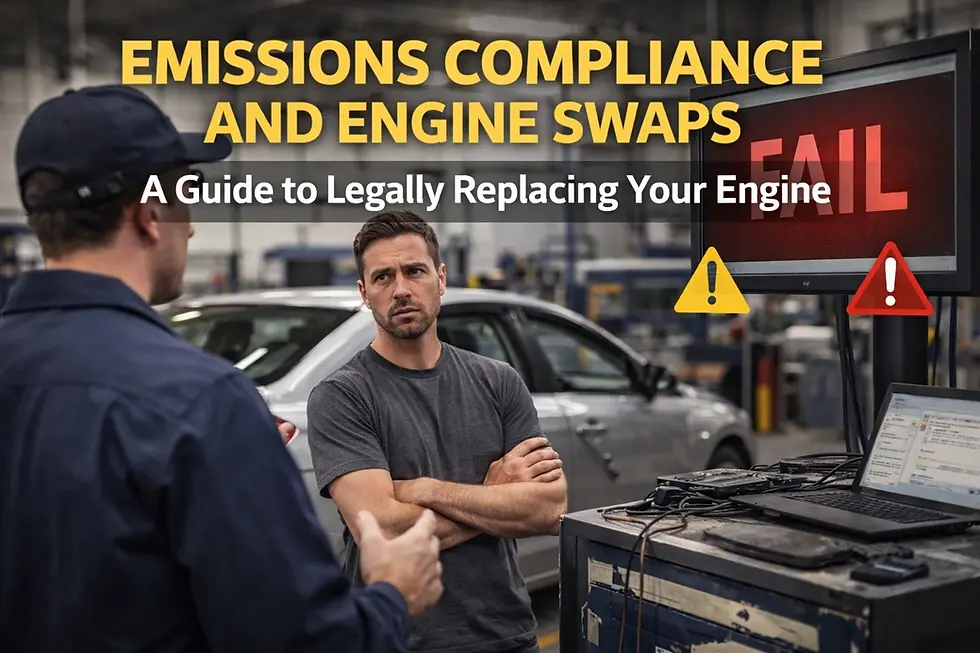
After fifteen-plus years in U.S. shops dealing with engine failures, replacements, and state inspections, I’ve learned one thing the hard way: engine replacement emissions rules can turn a “successful” swap into a registration-stopping problem even when the engine runs great. Most drivers focus on whether the engine fits and starts. Inspectors and vehicle computers focus on whether the engine belongs in that vehicle’s emissions configuration.
If you’re replacing an engine, especially a used engine purchased online, this isn’t just a mechanical decision. It’s a compliance decision tied to VIN matching, emissions family identification, and your state’s testing requirements (including CARB-compliant engine rules in California and CARB-adopting states). This guide breaks down what I’ve seen go wrong, why it happens, and the specific checks that keep a replacement engine from failing a smog check or stalling at readiness.
A Real Failure Scenario: The Engine Ran Perfectly, but the Car Still Failed
A few years ago, a customer brought in a late-model sedan that had just received a used engine purchased online. The installation itself went smoothly. The engine started right up, idled clean, and drove well on the road test. On the surface, it looked like a successful replacement. The customer was relieved until it was time for the emissions inspection.
The car failed. Not barely. It failed hard.
No matter what we checked, oxygen sensors, catalytic converter efficiency, fuel trims, or the readiness monitors, they would not complete properly. After several diagnostic sessions, the real issue became clear: the replacement engine came from a different emissions family than the original, even though it was the same year, same model, and same engine size. Mechanically, it fit. Electronically, it ran. Legally, it did not belong in that car.
The engine had to come back out.
That single mistake turned what should have been a cost-effective engine replacement into one of the most expensive repairs that the customer had ever dealt with. And the worst part? The seller wasn’t technically wrong. The engine ran. The problem wasn’t mechanical failure; it was emissions compliance.
After more than 15 years of diagnosing engine failures, supervising replacements, and handling emissions inspections across multiple states, I can tell you this clearly: emissions rules are one of the most misunderstood and most expensive parts of engine replacement in the United States.
This article explains how emissions laws really work when replacing an engine, why they cause so many problems, and what you absolutely need to understand before ordering a replacement engine, used or new.
Why Emissions Problems Happen So Often in the USA

The United States has one of the most complex emissions enforcement environments in the world, especially when it comes to engine replacement. Unlike many countries where inspections are minimal or inconsistent, large portions of the U.S. require emissions testing tied directly to vehicle registration. That makes compliance a real-world issue, not a “maybe later” issue.
At the same time, Americans keep vehicles on the road longer than most markets. Engines fail, but the rest of the vehicle is often still perfectly usable. That makes engine replacement common and emissions compliance unavoidable. This is also why used engines are so popular: they’re practical, but they’re also where mistakes multiply if buyers treat fitment as the only requirement.
Another key factor is how engines are sourced. With online marketplaces, engines move freely across state lines. An engine pulled from a vehicle in a non-testing state may end up installed in a strict-testing state. What passes unnoticed in one location becomes a registration-blocking issue in another.
Labor costs compound the problem. Once an engine is installed and fails emissions, the cost to remove it again is often higher than the cost of the engine itself. That’s why emissions mistakes hurt so much when they’re discovered late, after the most expensive work is already done.
What Most Buyers Get Wrong Before They Even Start Shopping
The most common misunderstanding is assuming emissions compliance is automatic if the engine “fits.” I’ve heard countless variations of the same belief: “If it’s the same year and engine size, emissions won’t be an issue.”
That assumption is wrong more often than people realize. Modern vehicles are not just “engine size and cylinders.” They are calibrated systems. The ECU expects specific signals, sensor behavior, and catalyst performance patterns. If the engine’s emissions configuration doesn’t match, the car may drive fine while still failing the test.
Another mistake is believing emissions problems will show up immediately. In reality, many engines run perfectly well but never complete readiness monitors. The vehicle drives fine, but inspection systems see incomplete data and fail it anyway. This is where first-time buyers get blindsided: “But it runs great” doesn’t matter if the inspection system can’t validate the emissions system.
Buyers also tend to think emissions responsibility lies with the seller or installer. In most cases, it does not. Legally and practically, emissions compliance becomes the owner’s responsibility once the engine is installed. If the engine can’t pass smog or complete readiness, the vehicle is effectively stuck.
When buyers don’t factor emissions rules into their decision early, they often discover the problem when there are no easy solutions left.
VIN Matching: The Single Most Important Emissions Safeguard

VIN matching is not just about mechanical compatibility. It is the foundation of emissions compliance. If you want one “gate” that prevents the biggest engine swap headaches, it’s this one.
Your VIN encodes:
The engine variant
The emissions family
Federal or CARB certification
Sensor and calibration logic
Two engines that look identical externally can belong to different emissions families internally. Installing the wrong one may not cause drivability issues, but it will almost always cause inspection problems. This is where used engine swap decisions go sideways: fitment is visible, but compliance is hidden.
I’ve seen engines that ran flawlessly but failed emissions simply because one component or calibration didn’t match what the vehicle’s computer expected based on the VIN. That mismatch might not throw a dramatic symptom. It might just stall readiness. And a stalled readiness set is a failed inspection in many states.
If an engine is not VIN-matched, emissions compliance becomes a gamble. And once the engine is installed, that gamble becomes expensive.
Emissions & State-Level Compliance in the USA

Emissions enforcement in the United States operates on two main levels: federal standards and state-level adoption. Federal emissions rules apply nationwide, but states have the authority to adopt stricter standards. Many states follow California’s CARB regulations, which impose additional requirements on engine swaps and replacements.
In CARB-regulated states, engines must:
Match the original emissions certification
Retain all emissions equipment
Be from the same or newer model year
Meet specific documentation requirements
Here’s the practical truth I’ve seen repeatedly: an engine that is perfectly acceptable in a federal-only state may be illegal in a CARB state. That’s not a minor technicality. That can mean a car that can’t be registered. A buyer hears “same year, same model,” but the state hears “wrong emissions certification.”
Understanding your state’s rules before buying an engine is not optional; it is essential. If you’re in a CARB state, you’re not just asking, “Will it run?” You’re asking, “Will it pass inspection and stay legal?”
Mileage, Testing, and Engine Condition Don’t Override Emissions Rules
Mileage and condition matter for longevity, but they do not override emissions requirements. This is where I’ve seen smart buyers still lose money: they did all the right “engine health” checks and still ended up with an engine they couldn’t register.
I’ve seen low-mileage engines rejected at inspection because they lacked proper emissions certification. I’ve also seen high-mileage engines pass easily because they were the correct emissions match. That contrast surprises people, but it’s exactly how the system works: the inspector doesn’t care about your compression numbers if the emissions setup doesn’t match.
Testing tells you how healthy an engine is. Emissions compliance tells you whether it can legally stay in the vehicle. Those are two separate filters, and both matter.
Buyers often prioritize mileage and testing results without realizing that emissions mismatches make those factors irrelevant. An engine that cannot be registered has zero practical value, regardless of how well it runs.
Engine Codes, Variants, and Emissions Differences
Manufacturers often change emissions strategies mid-production. This is the part that makes first-time buyers feel like the system is unfair, because two engines can look identical while being completely different from a compliance standpoint.
These changes may involve:
Different catalytic converter configurations
Revised sensor placement
Updated ECU programming
Modified exhaust gas recirculation systems
These differences don’t always show up in basic engine descriptions. They are often tied to engine codes, build dates, or VIN ranges. That’s why I push buyers to confirm the engine code and calibration compatibility, not just “same model year.”
I’ve diagnosed multiple cases where the engine code mismatch caused persistent emissions faults that could not be corrected without replacing the engine again. You can swap sensors, chase oxygen sensor readings, and replace parts, but if the underlying emissions family and calibration logic don’t match, you’re fighting the vehicle’s computer, not a faulty part.
This is why engine codes matter just as much as mileage or price when emissions compliance is a concern.
What Online Engine Listings Usually Don’t Tell You About Emissions

Most online listings focus on fitment and mileage. Emission details are often missing or glossed over. In practice, that means the listing tells you what you want to hear (“fits your vehicle”) without telling you what you actually need (“matches your emissions family and inspection requirements”).
Listings rarely explain:
Emissions family compatibility
CARB vs. federal certification
Readiness monitors behavior.
Inspection implications
Some sellers explicitly state that emissions compliance is the buyer’s responsibility. Others don’t mention it at all. Either way, the risk remains with the buyer. That’s why my advice is consistent: silence is not confirmation. The absence of emissions information should never be interpreted as compatibility.
If you’re buying online, you have to pull the missing details out of the process with specific questions and documentation requests.
Warranty Reality When Emissions Problems Appear

Emissions failures are one of the least protected issues under engine warranties. This catches people off guard because they assume warranty equals safety. In real shops, warranties are narrower than buyers expect.
Most used engine warranty covers internal mechanical failure, not inspection failure. If an engine runs but fails emissions, warranty coverage is often denied. That denial is brutal for first-time buyers because the engine feels “bad” in the only way that matters (it can’t pass inspection), but it doesn’t meet the warranty definition of “failed.”
I’ve handled many warranty disputes where the engine was technically “good” but unusable. The seller replaced nothing. The buyer paid everything. That’s not a morality story; it’s a contract story. The warranty language usually supports the seller on emissions-related failures.
Understanding that warranties do not equal emissions protection is critical before making a decision.
Installation Reality in the United States
Installation shops are increasingly cautious about emissions liability. That caution didn’t come from nowhere. It came from years of shops getting dragged into problems created by mismatched parts, unclear sourcing, and unrealistic customer expectations.
Many reputable shops:
Require proof of emissions compatibility before installation
Refuse to install engines of unknown origin
Limit their warranty coverage when customer-supplied engines are involved
This isn’t about being difficult; it’s about avoiding liability for decisions they didn’t make. If a shop installs an engine and the car fails emissions, the customer often points at the shop first, even when the engine choice was made elsewhere.
If a shop is hesitant to install an engine due to emissions concerns, that hesitation should be taken seriously. In my experience, a cautious shop often saves you from an expensive mistake.
The Most Expensive Emissions Mistakes I’ve Seen
The most expensive cases all share one thing in common: emissions were treated as an afterthought. People assumed they could “figure it out later,” and later turned out to mean after the engine was already installed and the registration deadline was approaching.
I’ve seen:
Engines removed twice
Vehicles sidelined for months
Thousands were lost on labor alone.
Owners forced to sell otherwise good cars
All because emissions rules were not understood upfront. These aren’t rare edge cases. They happen regularly, especially with online engine purchases and cross-state sourcing.
When a buyer learns this lesson the hard way, it’s not because they didn’t care. It’s because nobody taught them that emissions compliance is a first step, not a final step.
A Step-by-Step Professional Emissions Checklist Before Ordering

This is the checklist I give customers before approving an engine replacement. It’s written to prevent the “runs fine but fails smog” scenario that I’ve seen derail so many swaps.
Please verify the emissions regulations for your state. This matters because inspection requirements differ widely. What passes in one state may fail in another, and the difference is often legal, not mechanical.
Verify VIN-level engine compatibility. VIN matching is the fastest way to align the engine variant, emissions strategy, and sensor calibration to what your vehicle is designed to accept.
Confirm emissions family match. “Same year and model” is not enough. Emissions, family, and certification are where swaps get rejected during inspection, even when the engine runs well.
Retain all original emissions equipment. Missing, swapped, or incorrect emissions components can stall readiness monitors and trigger inspection failures even if the engine itself is healthy.
Ask about readiness monitor behavior. The engine can drive perfectly and still fail if the monitors don’t complete. A seller who understands this can often help confirm what to expect.
Document compliance before shipping. Once the engine ships and is installed, your leverage and flexibility drop sharply. Documentation protects you when disagreements happen.
Involve your installer early. A good shop will flag issues you might miss, especially in CARB states or strict testing areas.
If any step cannot be confirmed, pause the purchase.
Frequently Asked Questions From Real U.S. Vehicle Owners
Below are the questions I hear most often at the counter, especially from first-time engine buyers. These are also the long-tail questions that tend to come up right before an inspection appointment.
Can an engine run fine but still fail emissions testing?
Yes. Very commonly. The vehicle can feel normal while readiness monitors remain incomplete or the emissions system doesn’t match what the ECU expects.
Does the same year and model guarantee emissions compliance?
No. VIN and emissions family matter. I’ve seen “same year, same model” swaps fail because the replacement engine was certified differently.
How do I know if I need a CARB-compliant engine in California?
If your vehicle is registered in California or in a CARB-adopting state, CARB rules may apply. The safest approach is confirming CARB vs. federal certification before you buy, not after it’s installed.
Are used engines harder to pass a smog check with?
Not if they are correctly matched. A properly matched used engine can pass like any other engine. The problem is mismatches, missing equipment, or calibration differences.
Why won’t readiness monitors be set after an engine replacement?
Usually, it’s because the ECU is seeing signals that don’t align with its expected emissions configuration, or an emissions component/sensor setup doesn’t match the calibration logic.
Will a used engine warranty cover emissions failure?
Usually not. Most warranties cover internal mechanical defects, not inspection or compliance failures. If the engine runs but fails smog, many warranties consider it “operational.”
Can emissions issues be fixed after the engine is installed?
Sometimes, but often at high cost. If the issue is a missing component or a sensor problem, you may get lucky. If it’s the wrong emissions family or certification, the fix can be replacing the engine again.
What should I ask an online engine seller to avoid emissions problems?
Ask whether the engine is VIN-matched, whether it matches the emissions family and certification, and whether it is suited for your registration state’s requirements. If the answers are vague, that’s a risk.
Final Advice From a 15+ Year Automotive Engineer
After more than 15 years working with engine replacements across multiple states, I can say this with complete confidence: emissions rules matter just as much as engine condition, often more.
Most costly engine replacement failures I’ve seen were not caused by bad engines. They were caused by engines that didn’t belong in the vehicle under U.S. emissions law. That distinction matters because it changes how you shop, how you verify, and how you protect yourself.
When buyers understand emissions rules upfront, engine replacement becomes predictable and manageable. When they don’t, even a perfect engine can become a financial disaster.
The smartest engine replacement decisions are not rushed. They’re informed, verified, and compliant from the start. That approach doesn’t just save money; it saves time, stress, and vehicles that would otherwise be lost for the wrong reasons.
If you remember nothing else from this article, remember this: an engine that can’t pass emissions is not a replacement; it’s a problem waiting to happen.
Author Credibility
Written from the perspective of a U.S.-based automotive engineer and senior field technician with 15+ years of hands-on experience diagnosing engine failures, supervising engine replacements, resolving VIN mismatch cases, handling emissions inspections across multiple states, and working through real warranty disputes after installation. This guidance is built from shop-floor outcomes, what passes, what fails, and what costs drivers the most when compliance details are missed.


