
Nissan VQ35DE Engine Buyer's Guide
- David
- 11 minutes ago
- 8 min read
Nissan produced the VQ35DE from 2000 to 2020 across more platforms than almost any other V6 of its era: the Altima, Maxima, Murano, Quest, Pathfinder, and 350Z, plus the Infiniti G35, FX35, I35, and JX35. This extensive reach is precisely why purchasing a VQ35DE can lead to problems.
A VQ35DE from a 2003 350Z and a VQ35DE from a 2012 Altima share an engine code and almost nothing else. Different intake manifold. Different ECU calibration. Different accessory layout. One mounts longitudinally and drives the rear wheels; the other mounts transversely and drives the front.

This guide covers the three generations of the VQ35DE engine, the rev-up variant and how to verify it, the actual reliability record, the distinction between the VQ35DE and VQ35HR, and the checklist to review before making a purchase.
Nissan VQ35DE Engine Applications and Output by Platform
Vehicle | Years | Output | Layout | Notes |
2002–2018 | 240–270 hp | Transverse (FWD) | Highest-volume application | |
Nissan Maxima | 2002–2008 | 255–265 hp | Transverse (FWD) | Shares Altima architecture |
2003–2014 | 240–260 hp | Transverse (FWD/AWD) | CVT-paired; verify trans type | |
2004–2017 | 240–260 hp | Transverse (FWD) | Minivan calibration | |
Nissan Pathfinder | 2013–2020 | 260 hp | Transverse (FWD/AWD) | Late-production DE |
Nissan 350Z | 2003–2006 | 287–300 hp | Longitudinal (RWD) | Rev-up in 2005–2006 |
Infiniti G35 Sedan | 2003–2006 | 260–298 hp | Longitudinal (RWD) | Rev-up in 2005–2006 |
Infiniti G35 Coupe | 2003–2007 | 280–298 hp | Longitudinal (RWD) | Higher output than sedan |
Infiniti FX35 | 2003–2008 | 275–280 hp | Longitudinal (RWD/AWD) | SUV application |
Transverse and longitudinal VQ35DE units are not interchangeable. Although the engine code is the same, the mounting, accessory layout, and transmission interface are entirely different.
Nissan VQ35DE Engine Generations Explained
Early VQ35DE (2000–2004)
The first-generation VQ35DE arrived in 2000 and spread rapidly across Nissan's lineup. It uses a 3.5L aluminum block with DOHC 24-valve heads, forged steel connecting rods, a forged crankshaft, and continuously variable valve timing on the intake camshafts only. Bore and stroke measure 95.5 mm × 81.4 mm at 10.0:1 to 10.3:1 compression.
In the 2003–2004 350Z and G35, it produces 87 hp; in the same-era Altima and Maxima, 240–265 hp. The gap comes from intake design, exhaust routing, and ECU calibration, the rotating assembly is the same. These early units run a nylon intake manifold and are the generation most associated with oil consumption. Before judging a high-mileage unit, understand why a used engine burns oil. Here it is often design, not neglect.
The Rev-Up VQ35DE (2005–2006)
Nissan revised the VQ35DE for the 2005 350Z and G35 with what enthusiasts call the rev-up engine. The revision added electrically actuated variable valve timing on the exhaust camshafts, increased valve lift to 10.59 mm, shortened the intake manifold runners, and upgraded the oil pump. Redline rose to 7,000 RPM from 6,600, and output rose to 298–300 hp.
The rev-up is the most sought-after VQ35DE variant and the one sellers most frequently misrepresent. Verify it two ways. Count the VTC actuator circles on the cam covers: a rev-up shows two per side, a non-rev-up shows one. Then decode the donor VIN and confirm a 2005–2006 350Z or G35. Every 2005–2006 G35 6-speed manual received the rev-up; automatics did not. Always verify the seller's claims, as the exhaust cams are not interchangeable.
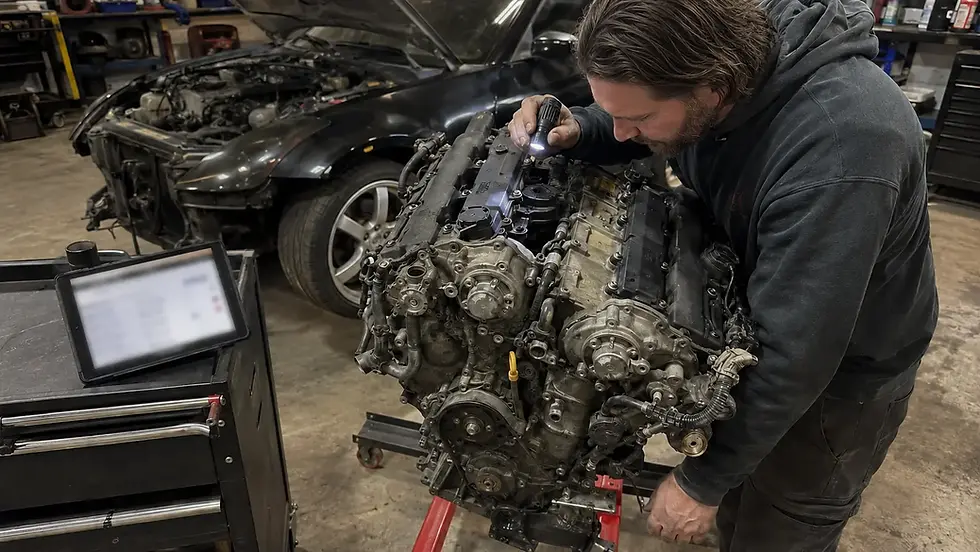
Late VQ35DE (2007–2020)
After 2006, Nissan moved the RWD platforms to the VQ35HR. The VQ35DE continued in transverse FWD and AWD applications, including the Altima, Murano, Quest, Pathfinder, and the Infiniti JX35 and QX60, with a revised intake, updated ECU calibration, and an improved oil control ring design that measurably reduced earlier consumption. A 2020–2022 Maxima VQ35DE is a materially different engine from a 2003 Altima unit despite the shared code.
Most late-production units pair with Nissan's CVT. Confirm transmission type on both donor and recipient, because CVT-calibrated ECUs and flexplates differ from conventional automatics.
VQ35DE vs. VQ35HR: The Distinction That Costs Buyers Money
The VQ35DE and VQ35HR are different engines and are not interchangeable. Nissan replaced the VQ35DE with the VQ35HR in RWD applications starting in 2007. HR stands for High Revolution.
Spec | VQ35DE | VQ35HR |
Production years | 2000–2020 | 2006–2019 |
Redline | 6,600–7,000 RPM | 7,500 RPM |
Output | 240–300 hp | 306 hp |
Block deck | Standard | Raised 8.4 mm |
Compression ratio | 10.0–10.3:1 | 10.6:1 |
Valve timing | Intake CVTC (exhaust eVTC on rev-up only) | Intake CVTC + exhaust eVTC |
Applications | Broad, FWD, and RWD | 350Z, G35, M35, EX35, FX35, Q50/Q70 Hybrid |
Interchangeable with DE? | — | No |
The VQ35HR raises the block deck 8.4 mm to reduce piston side-loading, lengthens the connecting rods, and adds a ladder-type main cap girdle to support the higher redline. It uses a redesigned cylinder head, its ECU, its harness, and a different accessory layout. A VQ35HR does not drop into a 2005 350Z without engineering work, and a VQ35DE does not replace a VQ35HR.
The HR also ran far longer than most listings suggest: the 2007–2008 G35, the 2006–2010 M35, the 2011–2012 Infiniti FX35, the 2008–2012 EX35, and the Q50 and Q70 hybrids through 2019.
VQ35DE Reliability: The Real Record
The Nissan VQ35DE delivers 200,000 to 300,000 miles of service life when maintained on a consistent oil change schedule. Its reputation problems come from two specific, well-documented failure modes, not from a fragile design.
Oil Consumption
Pre-2007 VQ35DE units commonly consume one quart per 1,000 to 2,000 miles once ring wear sets in. The cause is the design of the oil control rings combined with a PCV system that draws oil vapor back into the intake tract. Nissan revised the rings in later production. Consider consumption on an early unit above 120,000 miles as expected rather than defective, but please confirm the rate before making a purchase. Factory oil capacity is 4.8 liters with a filter change.
Timing Chain and Guides

The VQ35DE runs three timing chains with plastic-faced guides, and Nissan's practical service life for the assembly is roughly 150,000 miles. Worn guides produce a cold-start rattle that outlasts normal startup noise and eventually allows for chain slap and timing skip. A rattle lasting more than five seconds warrants inspection before purchase. Chain-driven engines fail differently from belt-driven ones; a chain rarely snaps without warning, but buyers routinely ignore that warning.
Valve Cover Gaskets and Valve Clearance
Valve cover gasket leaks are common past 100,000 miles. This is a maintenance item, not a structural failure, budget $200 to $400. The VQ35DE also uses solid shim-under-bucket lifters with no hydraulic adjustment, and Nissan specifies a clearance inspection every 60,000 miles, so a ticking top end may be drift rather than damage.
Precautionary Failure
Early Altima and Maxima applications suffered pre-catalytic converter breakdown, in which ceramic material is drawn back into the cylinders and scores the walls and piston rings. This is the single most damaging known VQ35DE failure mode. Owner-reported failures cluster between 70,000 and 142,000 miles, and the end state is engine replacement, not a converter repair. On any early transverse unit, compression testing is not optional.
What to Verify Before Buying a Used VQ35DE
1. Confirm layout first. Transverse or longitudinal. A 350Z engine does not fit an Altima, and an Altima engine does not fit a G35. Match the donor to the recipient platform before discussing price.
2. Verify rev-up status by cam cover and VIN. Count the VTC actuator circles: two per side is a rev-up, one per side is not. Then confirm the donor VIN maps to a 2005–2006 350Z or G35. The premium on a rev-up is real, and so is the misrepresentation rate.
3. Demand compression numbers. Nissan's factory specification is 1,275 kPa (185 psi) standard and 981 kPa (142 psi) minimum, with a maximum differential of 98 kPa (14 psi) between cylinders at 300 RPM. Low compression on one or two cylinders of an early Altima or Maxima unit strongly suggests precat scoring. Do not buy without numbers on paper.
4. Request a cold-start video. A rattle from the timing chain appears on a cold start and is the clearest indicator of chain wear. A seller who sends no samples is not worth your time.
5. Check oil condition and the PCV system. Sludged oil indicates extended drain intervals; a clogged PCV valve accelerates oil consumption. Apply the same discipline as when inspecting any used engine before buying.
6. Confirm accessories and sensors are included. A complete VQ35DE ships with an intake manifold, alternator, power steering pump, and sensors. A bare long block adds $400 to $900, never shown in the listing price.
7. Verify transmission pairing. Late transverse units pair with Nissan's CVT. Be sure to verify if the donor is a CVT or conventional automatic since the flexplate and ECU calibration differ.
8. Weigh the JDM option carefully. JDM VQ35DE units often carry lower verified mileage because Japan's shaken inspection regime retires vehicles early. A documented JDM unit at 60,000–90,000 km is a different asset from a domestic unit at 150,000 km. Confirm you are buying an OEM used engine, not a remanufactured or crate unit.

VQ35DE Fitment You Can Trust
Blue Prism Automotive supplies OEM used Nissan VQ35DE engines, including JDM-sourced units, with donor platform, layout, and mileage documented before shipping. Every sale starts with your recipient VIN. We match transverse to transverse and longitudinal to longitudinal and confirm rev-up status against the donor VIN when a rev-up is requested. No aftermarket rebuilds. No generic “Nissan 3.5 V6” listings without a confirmed platform. Every engine ships with a 181-day warranty and free nationwide shipping.
Frequently Asked Questions
What is the Nissan VQ35DE engine?
The VQ35DE is Nissan's 3.5-liter naturally aspirated DOHC V6, produced from 2000 to 2020. It uses an aluminum block, 24 valves, and forged steel connecting rods and produces 240 to 300 hp depending on application.
What vehicles use the VQ35DE engine?
The VQ35DE powers the Nissan Altima 3.5 (2002-2018), Maxima (2002-2008, 2020-2022), Murano (2003-2014), Quest (2004-2017), Pathfinder (2013-2020), and 350Z (2003-2006), plus the Infiniti G35 (2003-2007), FX35 (2003-2008), I35, and JX35. Transverse and longitudinal versions are not interchangeable.
Is the VQ35DE a reliable engine?
Yes. The VQ35DE commonly reaches 200,000 to 300,000 miles on consistent oil changes. Its two known weaknesses, oil consumption on pre-2007 units and pre-catalytic converter failure on early transverse applications, are both detectable before purchase with a compression test.
How many miles does a VQ35DE last?
A well-maintained VQ35DE lasts 200,000 to 300,000 miles. Timing chains typically need attention around 150,000 miles and valve clearance every 60,000 miles. Early failures come from extended oil change intervals or pre-catalytic converter debris damage, not wear-out.
What is the difference between VQ35DE and VQ35HR?
The VQ35HR has a block deck raised 8.4 mm, longer connecting rods, 10.6:1 compression, and variable valve timing on both intake and exhaust cams. It revs to 7,500 RPM and makes 306 hp. The two engines are not interchangeable and need different ECUs, harnesses, and accessories.
What is a rev-up VQ35DE?
The rev-up is the revised 2005-2006 VQ35DE fitted to the 350Z and G35. It adds electric variable valve timing on the exhaust cams, 10.59 mm valve lift, shortened intake runners, and an upgraded oil pump, raising output to 298-300 hp and redline to 7,000 RPM. Two VTC actuator circles per cam cover identify one.
Why does the VQ35DE burn oil?
Pre-2007 VQ35DE engines burn oil because of oil control ring design combined with a PCV system that pulls oil vapor into the intake tract. Consumption commonly reaches one quart per 1,000 to 2,000 miles above 120,000 miles. Nissan revised the rings in later production.
What is pre-cat failure, and how does it damage a VQ35DE?
Precat failure occurs when the pre-catalytic converter's ceramic substrate breaks down and debris is drawn back into the cylinders, scoring the walls and piston rings. Owner reports cluster between 70,000 and 142,000 miles, and the outcome is engine replacement, not a converter repair.
Can a 350Z VQ35DE be swapped into an Altima?
No. The 350Z VQ35DE mounts longitudinally for rear-wheel drive, and the Altima VQ35DE mounts transversely for front-wheel drive, using different oil pans, accessory brackets, intake manifolds, and transmission interfaces. A shared engine code does not make them interchangeable.
What should I check before buying a used VQ35DE engine?
Confirm the layout matches your vehicle, verify rev-up status by cam cover and donor VIN, and demand compression numbers against Nissan's 185 psi standard and 14 psi maximum cylinder differential. Then request a cold-start video, inspect the oil and PCV valve, and confirm accessories are included.
Where can I buy a used VQ35DE with verified fitment?
Blue Prism Automotive supplies OEM-used and JDM-sourced VQ35DE engines with donor platform, layout, and mileage documented. Every order begins with your recipient's VIN so fitment is confirmed before shipping, and each unit carries a 181-day warranty. Call (430) 413-4976.


